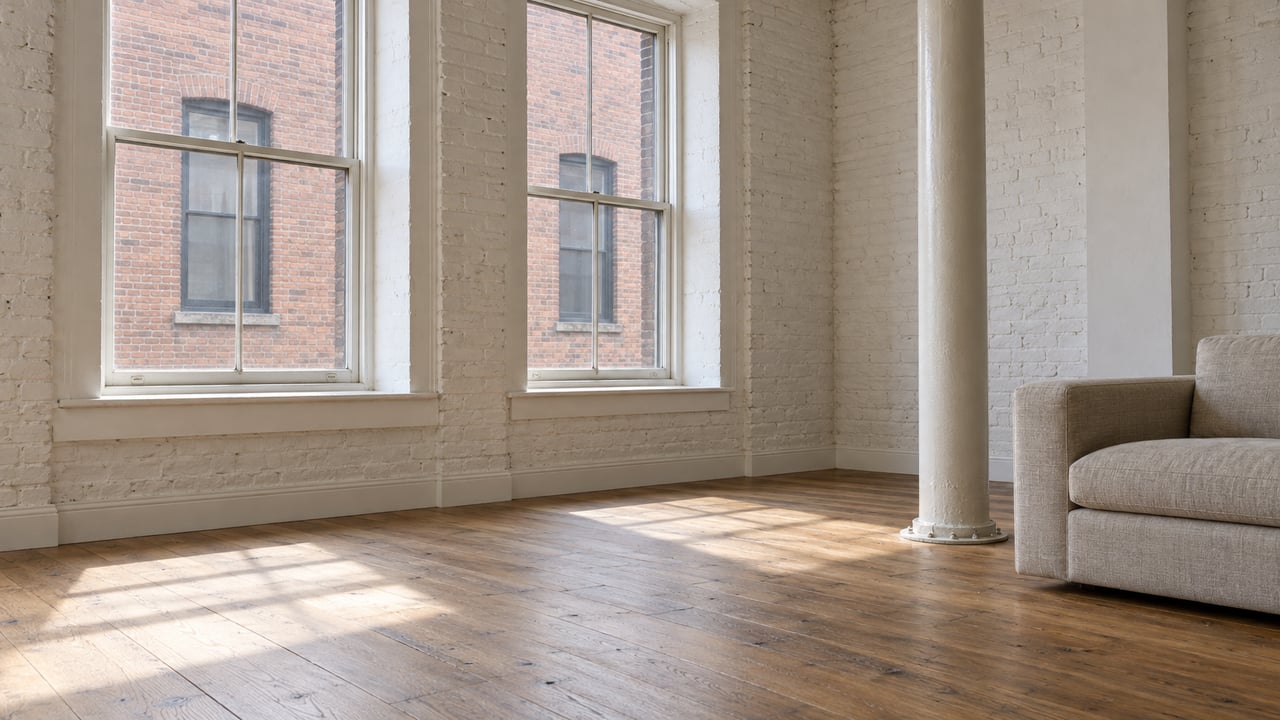
SoHo Artist Loft Conversion Fee: What It Means at Resale
October 15, 2026
October 15, 2026
"Petitioners may desire a property interest in a more valuable and less restrictive form, and they may want it without strings attached, but the opportunity to relinquish one form of property to acquire another, in exchange for a monetary payment to an arts fund, is not a taking." Judge Jenny Rivera wrote that in the New York Court of Appeals' 6-1 decision on January 13, 2026, as The Real Deal reported.
The "strings" are the SoHo-NoHo Arts Fund contribution. It is a one-time, per-square-foot payment that converts a Joint Living-Work Quarters for Artists unit, known as JLWQA, into ordinary residential use. The Department of City Planning lists the rate at $115.76 per square foot.
The fee often comes up at the moment a SoHo loft changes hands, even though the people already living in these units are protected. Under the 2022 state law, that protection belongs to qualifying occupants and does not pass with the apartment. A buyer who has no independent right to occupy inherits the unit's designation without its owner's grandfathered status. In practice, that gap gets priced into the deal.
The numbers explain why this matters. As of 2022, only 36 of the city's 1,636 JLWQA units were occupied by certified artists, and the city had certified fewer than 100 artists in the previous decade, according to The Real Deal. Almost everyone living in these lofts did not meet the original 1971 rule.
New York fixed that for current residents in July 2022. It amended Multiple Dwelling Law §276 so that any permanent occupant whose residence began on or before December 15, 2021 "shall be deemed to meet such occupancy requirements under the same right as a certified artist," according to the Department of Buildings' JLWQA guidance. The rezoning itself left each unit's occupancy status unchanged.
That protection is tied to a date and a person. A seller whose permanent residence began before the cutoff can qualify. A buyer moving in today starts after the cutoff, so the 2022 amendment does not cover them. They can still occupy lawfully if they are a certified artist or are entitled to occupancy under another provision of law, as DOB's definition allows. DOB lays out how the sale works for a buyer who meets none of those tests:
An owner may choose to convert a unit for JLWQA use prior to a sale in order to sell to any occupant. Since the unit is a JLWQA, the conversion process described in this guidance will apply. An owner may also sell to a buyer who does not meet the definition of who may occupy a JLWQA, and the buyer would convert the unit as outlined in this guidance before taking occupancy.
DOB also states that a buyer who moves in without qualifying "may be subject to enforcement on the same basis as prior to the 2021 zoning change." So the conversion question first comes up at resale. That makes the purchase contract the place where someone has to decide who absorbs the cost.
The zoning text in ZR §143-13 set the original contribution at $100 per square foot as of December 15, 2021. It is adjusted every August 1 by the Consumer Price Index for the 12 months ending June 30. At the rate DCP currently lists, the fee on typical SoHo loft sizes works out as follows:
| Converted floor area | Fee at $115.76/sq ft |
|---|---|
| 1,500 sq ft | $173,640 |
| 2,500 sq ft | $289,400 |
| 3,500 sq ft | $405,160 |
| 5,000 sq ft | $578,800 |
For scale, brokerage-reported figures for the broader Downtown Manhattan submarket in Q3 2026 showed an average of $2,119 per square foot and a median sale price of $1.70 million. Against that average, the Arts Fund rate is about 5.5% of value per foot. That figure is a blend across all Downtown product, not SoHo lofts alone. Even so, the fee is large enough to show up in negotiations and too small to stop a deal on its own.
The zoning text adds a timing detail. The fee is "determined based upon the rate which is in effect at the time the contribution is received." The rate is set when the money reaches the fund, so a conversion paid after an August 1 reset is charged the new rate. The figures being discussed have already moved. In January 2026, the SoHo Alliance quoted the fee at $110 per square foot. Today DCP lists $115.76.
Enforcement has been rare. The Real Deal reported that the city rarely enforced the artist-residency requirements and that the Adams administration stopped efforts to increase penalties. The SoHo Alliance, a neighborhood advocacy group, went further in its January 18 bulletin. It wrote that in 55 years no non-artist had been evicted for failing to conform to an artist-certification certificate of occupancy. It also said the rezoning lists no fines for failing to convert and cited a $1,250 Administrative Code penalty for certificate of occupancy violations. Those are the group's claims and its own reading of the law. They do not come from a city enforcement dataset.
None of this has made the fee disappear from deals. The same bulletin reported "a couple of reports that some prospective non-artist buyers of units with an existing JLWQA Certificate of Occupancy are utilizing the prospect of this huge fee to leverage a massive reduction in the asking price from sellers." No addresses or discount amounts were published. Still, the account shows where the fee does its work. A rule the city has rarely enforced can still become a hard number once a buyer prices the unit and a lender, attorney, or board reviews the certificate of occupancy.
The incentives line up this way. A seller protected under the 2022 amnesty has never had a reason to convert, because the protection costs them nothing. A buyer outside the amnesty sees a six-figure item tied to their own occupancy, and a value that depends on the unit's legal use rather than on the asking price alone. The Arts Fund rate gives both sides a precise per-foot number to argue over.
A January 23 alert from the law firm Belkin Burden Goldman described conversion as something that can widen the pool of buyers and tenants and may improve financing. Those are possible benefits, not documented outcomes. Our research found no named SoHo listing marketed as already converted and no public count of completed conversions.
The fee applies only to space with the JLWQA designation. Plenty of SoHo lofts fall outside it.
This is why two lofts on the same SoHo block can be in very different positions at resale. Their size, ceilings, and cast iron can match, and one can still carry the fee while the other does not. The building's certificate of occupancy and Loft Board history decide it.
When a conversion does happen, DCP's Arts Fund summary names the unit or building owner as the applicant and lays out a fixed order of steps.
DOB says a conversion confined to a single unit can be filed separately without triggering a building-wide conversion. The money goes to grants for artists and arts nonprofits in SoHo, NoHo, and neighborhoods south of 14th Street, overseen by the Department of Cultural Affairs. An August 26, 2026 City Record notice names Lower Manhattan Cultural Council as the fund's grant administrator for FY26-27.
The case has gone through three courts. A state Supreme Court sided with the city. In December 2024, an Appellate Division panel reversed that ruling and found the fee unconstitutional. The Court of Appeals then reversed the Appellate Division in January 2026. The majority opinion held that the conversion option "has not extinguished or diminished petitioners' property rights in their JLWQA units." Judge Michael Garcia dissented.
The Coalition for Fairness in SoHo and NoHo, represented by Pacific Legal Foundation, filed a petition for certiorari on April 13, 2026, docketed as No. 25-1187. The Manhattan Institute, the Cato Institute, and Councilmember Christopher Marte filed amicus briefs, among others. The city opposed the petition on August 3, and the petitioners replied on August 17. The case was set for the September 28 conference, rescheduled on September 24, and distributed again for the Court's October 9, 2026 conference. As of October 12, the docket shows no order granting or denying review.
Until that order appears, the Court of Appeals ruling is the controlling decision. The fee is in effect at the rate DCP lists, and the conversion pathway is open. Any SoHo loft contract signed this fall is being priced while that question is still pending at the country's highest court.
If you own or are weighing a SoHo loft, the certificate of occupancy and the Loft Board history matter as much as the floor plan. The Heard Khedr Team can help you work out where a specific unit stands and how the Arts Fund question could affect its price. Book a Home Valuation to start with your building's records.
This article is general information, not legal, tax or financial advice. Consult a qualified professional about your situation.
Stay up to date on the latest real estate trends.
Get In Touch With Our Team To Learn More
Heema Khedr
110 Fifth Avenue, Floor 7 New York NY 10011